
What a Payment Architecture Audit Actually Finds: 3 Anonymized Risk Maps
An architecture audit does not hand you a list of bugs. It hands you a risk map - your platform's exposures ranked by severity and business impact, and the one thing to fix first. Here are three anonymized composite risk maps that show what an audit surfaces, and the pattern behind all of them.
Across this series we have taken the payment platform apart one failure class at a time: reconciliation that leaks money and time, cores that buckle at peak, ledgers stuck at T+2, cloud spend that grows faster than volume, integrations that decay into security gaps, licence applications that stall on missing evidence. Each of those articles ended at the same place - a scoped architecture assessment - because in practice they are never found one at a time. They are found together, on the same platform, in a single review.
This final article shows what that review produces. Not a scan report, not a list of CVEs, but a risk map: the platform's real exposures, mapped to the domains that matter, ranked by severity and business impact, with a clear answer to the only question that matters when the list is long - what do we fix first? Below are three anonymized composite risk maps, each a blend of patterns we see repeatedly, none a real client. They are illustrative of shape, not of any single platform.
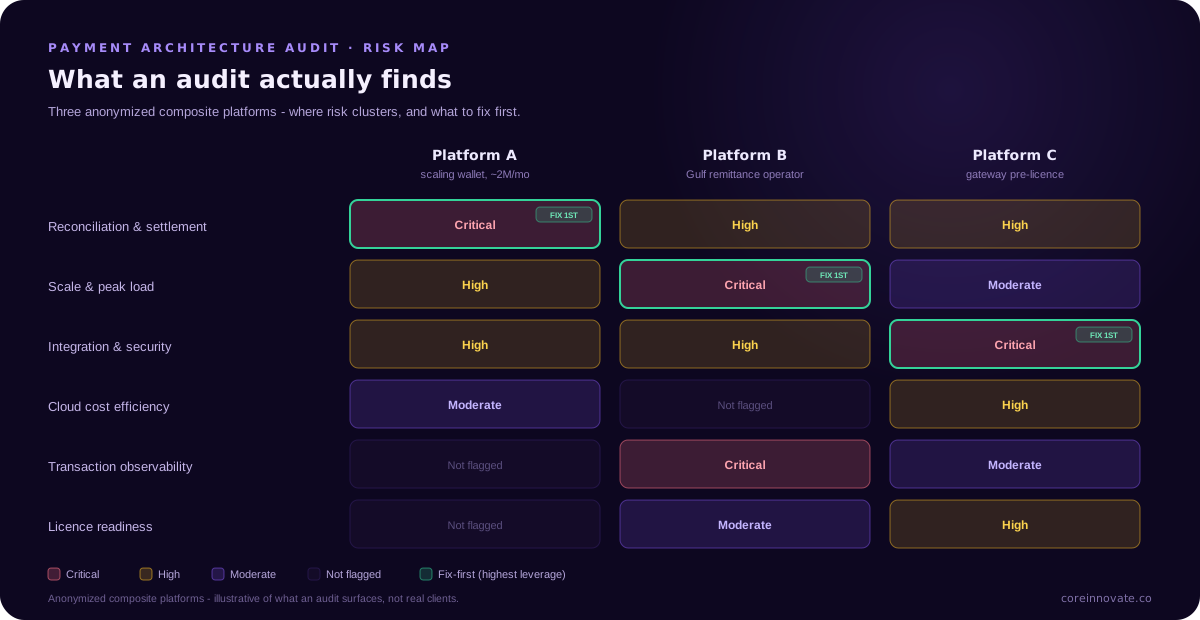
Risk Map A - the scaling wallet platform
A growth-stage wallet platform, a couple of million transactions a month, moving fast. The audit surfaces a familiar cluster.
The ledger is reconciled by a nightly batch, which means settlement is stuck at T+2 and a reconciliation backlog builds on busy days - the single most consequential finding, because it caps both settlement speed and operational cost at once. Wallet and transaction endpoints show broken object-level authorization, a cross-tenant read risk. And compute is over-provisioned, with a recoverable slice of the cloud bill sitting idle. Individually manageable; together, a platform whose core cannot keep pace with its own growth.
Fix first: the ledger. Moving to a continuously-reconciled, event-sourced core is the highest-leverage change, because it is what unlocks same-day settlement and closes the reconciliation cost at the same time - one architectural change, two of the three findings resolved.
Risk Map B - the Gulf remittance operator
A high-volume exchange-house-descended remittance platform, dense with corridors and correspondent integrations. A different cluster, same method.
The legacy core buckles on peak weekends - the batch-versus-live collision we have written about - so payday and Eid produce timeouts and settlement backlogs on schedule. Correspondent integrations are over-scoped, and on at least one, TLS validation was disabled during bring-up and never restored. And there is no transaction-level observability, which means the platform is effectively blind to fraud and intrusion as they happen - a critical finding, because it makes every other risk harder to detect.
Fix first: peak resilience and the integration edge. The immediate exposure is operational and security-facing at once - isolate the hottest corridor so a surge stays contained, and harden the integration credentials and transport that a review of the five OWASP failures flags first.
Risk Map C - the gateway preparing for a licence
A growth-stage payment gateway readying a central-bank licence application. Here the audit reads partly as a readiness review.
Reconciliation evidence cannot be produced cleanly on demand - a direct licensing exposure, because "show me a reconciled position" is exactly what a technical reviewer asks. Inbound webhook callbacks are not signature-verified or idempotent, a replay-and-double-payout risk. And cloud cost is climbing faster than volume with no reservation strategy in place. A platform that works, but is not yet built to prove that it works.
Fix first: make the evidence a byproduct. The reconciliation and audit-trail work that satisfies the licence reviewer is the same work that closes the operational risk - build the core so that "show me" has a one-query answer, and the licence readiness and the day-to-day resilience improve together.
The pattern behind all three
Look across the three maps and the value of the exercise becomes clear. The findings are different, but they cluster in the same six domains every time - reconciliation and settlement, scale and peak load, integration and security, cloud cost, observability, and licence readiness. That is not a coincidence; it is because those are the domains where payment-platform architecture actually succeeds or fails. An audit is not a fishing expedition. It is a structured read of a known risk surface.
Two things are true of every map. First, the findings are architectural, not incidental - each traces back to how the system was built, which is why a scanner would miss most of them and why the fix is durable rather than a patch. Second, the findings are ranked and connected: the point of the map is not the list, it is the fix-first call, and in every case the highest-leverage first move resolves more than one finding at once. That prioritization - separating what is urgent from what is merely present, and finding the single change that unlocks several - is the entire value of the audit.
What you actually receive
A CoreInnovate architecture assessment produces exactly this, for your platform: a findings deck, a risk map ranked by severity and business impact, and a prioritized modernization roadmap - a senior payment engineer's direct read of where you are exposed and, more usefully, what to do about it and in what order. It is scoped, time-boxed, and delivered as a decision-ready artifact, not an open-ended engagement.
If any of the three maps above rhymes with your platform - the batch-bound ledger, the core that fails at peak, the integrations that have quietly decayed, the evidence you cannot yet produce on demand - the useful next step is to see your own map. That is what the assessment is for: to replace a vague sense that something is wrong with a ranked, specific, and actionable picture of exactly what, and exactly what to fix first.
CoreInnovate
Working on a payment platform challenge?
Our specialist engineers work directly with payment gateways, wallet providers, and fintech platforms. Start with a scoped architecture assessment.