
OWASP Part 3: Integration Security for PSP and Banking Rails
Part 2 named integration misconfiguration as the failure that grows fastest as a platform scales its partner count. This is the deep dive. Every connection to a PSP, correspondent bank, or partner is a trust boundary you have to prove and maintain - and here are the six controls that hold it, and the OWASP risks each one closes.
In Part 2 we listed the five OWASP failures that show up most often in Gulf remittance platforms, and flagged one as the failure that grows fastest with scale: security misconfiguration in PSP and correspondent integrations. The reason it grows is structural. Every corridor you add is another partner, another set of credentials, another integration built under deadline pressure - and the security posture set during that rush is almost never revisited once money is flowing. Integration security debt accumulates as a direct function of how many partners you connect and how long ago you connected them.
This third and final article in the series is the deep dive that failure deserves. A payment platform is not one system; it is a hub joined to PSPs, acquirers, correspondent banks, screening providers, and payout partners by dozens of integrations. Each of those joins is a trust boundary - a place where your platform trusts, and is trusted by, something outside your control. Getting integration security right is a matter of proving and maintaining that trust on every connection. Here are the six controls that do it, and the OWASP risk each one closes.
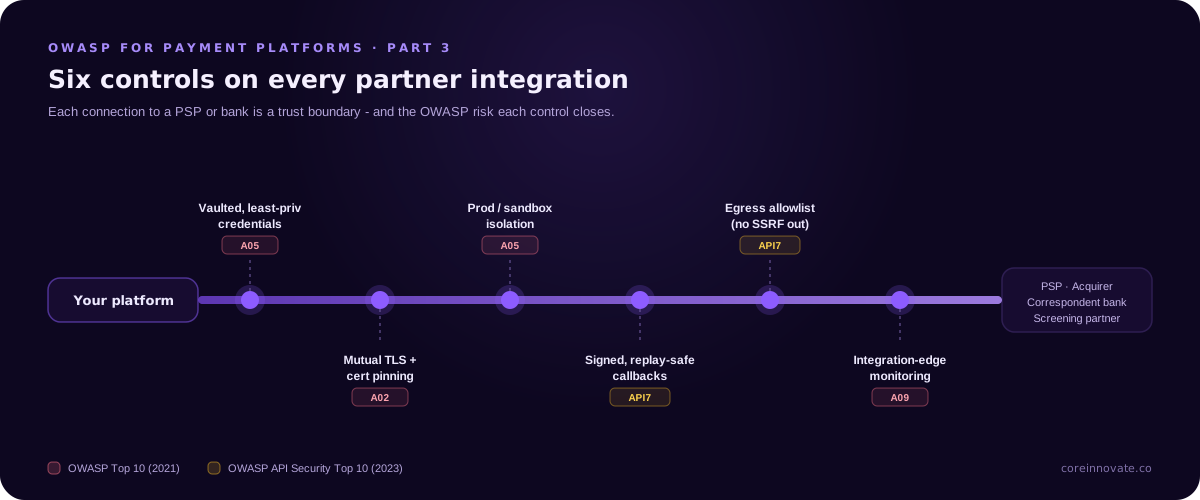
1. Vaulted, least-privilege, rotated credentials
Closes: OWASP A05 - Security Misconfiguration (and the secrets-management failures beneath it).
Every integration authenticates with something - an API key, a client secret, a certificate, an SFTP key. The recurring failure is not that these exist, but how they are scoped, stored, and aged. We find partner credentials provisioned with far broader permissions than the integration uses, so a single leaked key can do far more than its purpose requires. We find them pasted into environment variables, config files, and occasionally committed to a repository. And we find them never rotated, so a credential exposed years ago is still live today.
The control is threefold: least privilege (each credential scoped to exactly the operations that corridor needs, and no more), vaulted storage (secrets held in a dedicated secrets manager, never in code, env, or logs, and injected at runtime), and rotation (credentials rotated on a schedule and immediately on any suspicion, which is only practical when they live in a vault rather than scattered across the deployment). Get this wrong and every other control is built on a key an attacker may already hold.
2. Mutual TLS with certificate validation and pinning
Closes: OWASP A02 - Cryptographic Failures.
Connections to banks and PSPs must be mutually authenticated and encrypted - both sides proving identity, not just the client trusting a server certificate. The failures here are quiet and dangerous: certificate validation "temporarily" disabled during an integration bring-up and never re-enabled, leaving a corridor open to interception; missing mutual TLS where the partner supports it; and no certificate pinning on the most sensitive connections, so a mis-issued or compromised certificate goes unnoticed.
The control is non-negotiable and simple to state: TLS verification is never disabled, in any environment, for any duration; mutual TLS is used wherever the partner supports it; and certificate pinning guards the connections that move the most value. The "temporary" disabled check is the single most common finding in this category, and the most reliably exploitable.
3. Production and sandbox isolation
Closes: OWASP A05 - Security Misconfiguration.
Integrations are built and tested against partner sandboxes, then promoted to production - and the boundary between the two is where a specific, dangerous class of bug lives. Sandbox and production configuration that share a code path let a test endpoint or a sandbox key leak into the live flow. Worse, we have seen production traffic reach a sandbox that silently succeeds without moving real money - the platform believes a payout happened that never did.
The control is hard isolation: production and non-production are separated by configuration that cannot silently cross over - ideally by full environment isolation, at minimum by loud, fail-closed guards that refuse to run rather than quietly use the wrong endpoint. On a payment platform, a connection to the wrong environment is not a test failure; it is a settlement discrepancy or a fraud window.
4. Signed, replay-safe, idempotent callbacks
Closes: OWASP API7 / A04 - SSRF and Insecure Design (inbound edge).
This is the inbound half of the trust boundary, and Part 2 covered why it matters: PSP and correspondent callbacks move your platform's state and often move money, so a callback that is not authenticated and replay-protected is an open instruction to your ledger. An unsigned "payout succeeded" event can be forged; a signed but non-idempotent one can be replayed into a double payout.
The control, applied to every inbound callback: verify a cryptographic signature against the partner's key (not a shared secret in a query string), enforce a replay window and a checked event ID against an idempotency store, and process idempotently so that the deliberate re-delivery every serious provider performs is safe by construction. This is the same idempotency discipline from Building Idempotent Payment APIs, enforced at the partner boundary.
5. Egress allowlisting
Closes: OWASP API7 - Server-Side Request Forgery (outbound edge).
The outbound half is the one teams forget. Platforms that let partners register their own callback or notification URLs - and then fetch or post to those URLs from inside the network - hand an attacker a server-side request-forgery primitive pointed at internal services and cloud metadata endpoints. A partner-supplied URL is attacker-controllable input, and if your platform will dutifully connect to whatever it is given, it becomes a proxy into your own network.
The control: partner-supplied URLs are validated against an allowlist and resolved through an egress proxy that cannot reach internal address ranges. Outbound connections from the integration layer go only where they are explicitly permitted to go. The platform must be as careful about what it connects out to as what it accepts in.
6. Integration-edge monitoring
Closes: OWASP A09 - Security Logging and Monitoring Failures.
The five controls above can each be present and still silently degrade - a certificate expires, a credential is rotated by a partner but not by you, a sandbox config bleeds into a deploy, a callback signature starts failing. Without monitoring of the integration edge specifically, the first sign of any of these is an incident, not an alert.
The control is observability aimed at the boundary: monitor the health and security posture of every integration - certificate expiry and validation status, authentication failures, callback signature-verification failures, anomalous egress attempts, and unexpected changes in partner behavior - and alert on them as first-class signals. This is the transaction-critical observability discipline pointed at the partner boundary, and it is what turns the other five from one-time fixes into maintained controls.
The pattern, one last time
Across all three parts of this series the theme has held: payment security is not a patch-level concern, it is a property of how the system is built and maintained. Integration security makes that especially clear. None of these six controls is exotic; every one is a decision about how a trust boundary is designed and watched. And because integration debt grows with every partner you add, the platforms that stay secure are the ones that treat each new connection as a boundary to be proven - credentials scoped and vaulted, transport mutually authenticated, environments isolated, both edges of the callback trust boundary guarded, and the whole thing monitored - rather than a one-off wiring job to be finished and forgotten.
That is the review our work applies to your integration layer: not a scan for known-bad strings, but an architectural read of every trust boundary between your platform and the rails it depends on. If you want to know which of these six controls are solid on your platform and which have quietly decayed since the integration went live, our architecture assessment examines exactly that - and tells you where your partner boundaries would, and would not, survive scrutiny.
CoreInnovate
Working on a payment platform challenge?
Our specialist engineers work directly with payment gateways, wallet providers, and fintech platforms. Start with a scoped architecture assessment.