
OWASP for Payment Platforms, Part 2: The Five Failures We Find in Every Gulf Remittance Stack
Part 1 mapped the OWASP risk categories onto payment architecture. Part 2 gets specific. These are the five OWASP failures we find, over and over, when we review the remittance and exchange-house platforms moving money out of the Gulf - each with the exact scenario that exploits it and the control that closes it.
In Part 1 we argued that OWASP is not an annual checklist for payment platforms - it is the baseline your architecture is judged against, because in a system that moves money, a vulnerability is not a data-exposure risk, it is a payout. This second article makes that concrete for a specific and high-value context: the remittance and exchange-house platforms that move money out of the Gulf.
Gulf remittance is a distinctive engineering environment. High-volume corridors - UAE to India, UAE to the Philippines, UAE to Egypt - run through a mesh of correspondent banks, aggregators, and last-mile payout partners, under CBUAE oversight and tight settlement deadlines. Many of these platforms began as integrations bolted onto exchange-house core systems that predate the digital era. That combination - real money, dense third-party integration, legacy cores, regulatory scrutiny - produces the same five OWASP failures again and again. Here they are, in the order we most often find them exploitable.
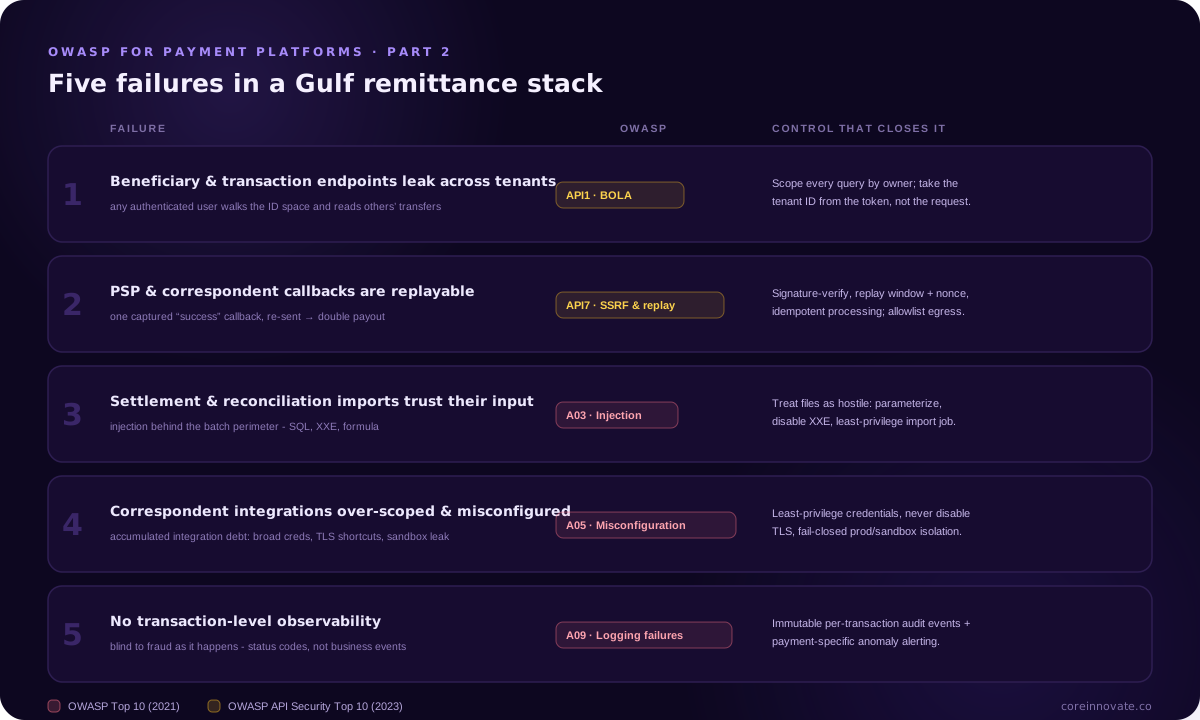
Failure 1: Beneficiary and transaction endpoints leak across tenants
OWASP API1:2023 - Broken Object Level Authorization (BOLA).
This is the single most common serious finding in remittance APIs, and the reason is structural: remittance is dense with object references. Every remittance is an object with an ID. So is every beneficiary, every sender KYC record, every payout instruction, every corridor rate quote. A mobile app or partner integration fetches these objects by ID - and if the endpoint authenticates the caller but does not verify that the caller owns the object, any authenticated user can walk the ID space.
The exploit is not sophisticated. An authenticated sender calls GET /transfers/{id} or GET /beneficiaries/{id}, increments or randomizes the ID, and reads other customers' transfers, beneficiary bank details, and - in the worst implementations we have seen - full sender KYC documents. On a remittance platform this is simultaneously a data-protection breach, a fraud-enablement gift (beneficiary details are exactly what a social-engineering payout-redirection attack needs), and a regulatory incident.
The control. Authorization must be enforced at the object level, on every endpoint, on the server, on every request - not "is this a valid session" but "does this principal own, or have an explicit grant to, this specific object." The reliable pattern is to scope every query by owner at the data-access layer (the tenant/customer ID comes from the authenticated token, never from a request parameter), so an object the caller doesn't own is not merely rejected - it is never selected in the first place. Object IDs should also be non-enumerable (UUIDs, not sequential integers) as defense in depth, but non-enumerability is not authorization and must never be relied on alone.
Failure 2: PSP and correspondent callbacks are replayable
OWASP API7 / A04 - Server-Side Request Forgery and Insecure Design in webhook handling.
Remittance platforms live on callbacks. A payout partner confirms disbursement via webhook. A correspondent bank posts a settlement status. A screening provider returns a sanctions result. Each of these inbound callbacks moves your platform's state - and often moves money or releases a hold. That makes the callback handler one of the most security-critical endpoints you operate, and one of the most consistently under-protected.
Two distinct failures live here. The first is replay: a callback that says "payout succeeded" or "funds received," if it is not idempotent and replay-protected, can be captured and re-sent - and a naive handler credits the ledger, releases the hold, or triggers the next leg again. We have seen a single genuine "success" callback replayed into a double payout. The second is SSRF on the outbound side: platforms that let partners register their own callback URLs, and then fetch or post to those URLs from inside the network, hand an attacker a request-forgery primitive pointed at internal services and cloud metadata endpoints.
The control. Every inbound callback must be authenticated by cryptographic signature (verified against the provider's key, not merely a shared secret in a query string), carry a replay window and a nonce or event ID that is checked against an idempotency store, and be processed idempotently so that re-delivery - which every serious provider does deliberately - is safe by construction. This is the same idempotency discipline we covered in Building Idempotent Payment APIs, applied to the inbound edge. On the outbound side, partner-supplied URLs must be validated against an allowlist and resolved through an egress proxy that cannot reach internal address ranges.
Failure 3: Settlement and reconciliation imports trust their input
OWASP A03:2021 - Injection.
Every remittance platform ingests files it did not generate: correspondent settlement files, partner payout reports, bank statement exports for reconciliation. These arrive as CSV, fixed-width, XML, or spreadsheet formats, often over SFTP, often processed by a batch job that runs with elevated database access and little of the input scrutiny that guards the public API. That job is a soft target hiding behind a hard perimeter.
The failure modes are classic injection, relocated to the batch layer: a settlement row whose "reference" field is concatenated into a SQL statement; a spreadsheet cell beginning with = that becomes a formula-injection payload when an operator opens the reconciliation export; an XML import parsed with external entity resolution enabled, turning a settlement file into an XXE file-read or SSRF vector. Because this path is internal and batch, exploitation is quiet - it does not show up in API logs, and the first symptom is often a reconciliation break or a data anomaly no one can explain.
The control. Treat every ingested file as hostile input, held to the same standard as a public request. Parameterize every query built from file data; never concatenate. Disable external entity resolution in every XML parser. Neutralize leading formula characters in any field that may be re-exported to a spreadsheet. Validate structure and value ranges before a single row touches the ledger, and run the import job under least-privilege database credentials scoped to exactly the tables it needs. Reconciliation integrity is a security property, not just an accounting one - a theme we go deeper on in Observability for Transaction-Critical Systems.
Failure 4: Correspondent integrations are over-scoped and misconfigured
OWASP A05:2021 - Security Misconfiguration.
A Gulf remittance platform is a hub of credentials: API keys for each payout partner, mTLS certificates for correspondent banks, screening-provider tokens, SFTP keys. These integrations are almost always built under deadline pressure to open a corridor, and the security posture set during that rush is rarely revisited once money is flowing. Misconfiguration accumulates as a function of integration count and integration age.
The recurring findings: partner credentials provisioned with far broader scope than the integration uses, so a single leaked key can do far more than its purpose requires; sandbox and production configuration sharing a code path, so a staging endpoint or test key leaks into the live flow (or worse, production traffic reaches a sandbox that silently succeeds without moving money); TLS certificate validation disabled "temporarily" during an integration bring-up and never re-enabled, leaving a corridor open to interception; and verbose error responses that leak partner endpoints, internal hostnames, and stack traces to anyone probing the API.
The control. Every integration credential is least-privilege by default and scoped to exactly the operations that corridor requires. Production and non-production are separated by configuration that cannot silently cross over - ideally by environment isolation, at minimum by loud, fail-closed guards. TLS verification is never disabled, in any environment, for any duration. Error responses are generic to the caller and detailed only in internal logs. And integration configuration is reviewed on a schedule, not just at launch - because the risk here grows quietly with every corridor you add. This is exactly the kind of accumulated integration debt our payment platform re-architecture work is built to unwind.
Failure 5: No transaction-level observability means you are blind to fraud
OWASP A09:2021 - Security Logging and Monitoring Failures.
In a general web application, poor logging means slow incident forensics. In a remittance platform, transaction-level observability is the fraud and intrusion detection layer - and its absence is not a slow-forensics problem, it is an actively-funding-the-attacker problem. Every one of the four failures above is far more dangerous when no one can see it happening.
What we find: logs that record HTTP status codes but not the business event (which account, which corridor, which amount, which state transition); no alerting on the signals that actually indicate compromise on a remittance platform - a spike in failed authorization checks, an unusual velocity of beneficiary changes, a payout callback for a transfer that has already settled, a reconciliation delta that crosses a threshold; and audit trails that are incomplete, mutable, or so noisy that the one anomalous line is invisible. When the incident comes, the team cannot answer the only questions that matter: what moved, to where, and when did it start.
The control. Every money-affecting action produces a structured, immutable audit event carrying the business context - principal, object, corridor, amount, before/after state - not just a request log. Detection rules fire on payment-specific anomalies, not just infrastructure metrics. And the whole thing is testable: you should be able to inject a synthetic version of each of the failures above and watch your monitoring catch it. If you cannot see it, you are funding it.
The pattern behind all five
Read the five together and the theme from Part 1 returns: none of these are patch-level bugs. Broken object authorization is a data-access-layer design decision. Replayable callbacks are an idempotency-and-trust design decision. Injection through imports is a question of where you draw the trust boundary. Over-scoped integrations are an accumulation of architectural shortcuts. Missing observability is an architectural omission. Every one is a consequence of how the system was built - which is why, on a payment platform, a security review and an architecture review are substantially the same review.
That is also why scanning tools alone will not find most of these. A scanner can flag a missing TLS check; it cannot tell you that merchant A can read merchant B's beneficiaries, or that your payout handler credits the ledger twice on a replayed callback, or that your reconciliation import trusts a hostile file. Those require someone who understands both the OWASP category and how money actually moves through your specific corridors.
Where this is heading
Part 3 of this series goes deep on Failure 4 - integration security for PSP and banking rails - because it is the failure that grows fastest as a platform scales its corridor count, and the one most often invisible until an audit or an incident surfaces it.
If you would rather know now which of these five are live in your stack, that is exactly what our architecture assessment is scoped to find: a senior payment engineer reviews your authorization boundaries, callback handling, import paths, integration configuration, and transaction observability against this baseline, and gives you a direct, prioritized read on what is exposed and what to fix first.
A note on regulatory specifics: this article describes engineering failure modes, not compliance advice. CBUAE and other Gulf regulatory requirements evolve; validate any compliance-facing claim with a qualified professional before acting on it.
CoreInnovate
Working on a payment platform challenge?
Our specialist engineers work directly with payment gateways, wallet providers, and fintech platforms. Start with a scoped architecture assessment.