
Preparing Your Payment Stack for a Central Bank Licence Application in the UAE
A UAE payments licence application is also a technology review. The regulator does not just ask whether your controls exist - it asks you to prove it, with evidence your architecture either can produce or cannot. Here are the eight engineering-readiness domains to get right before you apply.
This article is engineering-readiness guidance, not legal or compliance advice. Licensing requirements are set by the Central Bank of the UAE (CBUAE) and evolve; the specifics of your application must be confirmed with a qualified legal or compliance professional. What follows is about the technology posture that regulatory scrutiny consistently expects - the part that lands on the engineering team's desk.
Most fintech founders approach a payments licence as a legal and capital exercise: the right entity, the right paid-up capital, the right policies on paper. All necessary. But somewhere in the process, the questions turn technical, and they turn specific. Can you demonstrate that customer funds are reconciled daily? Can you produce a complete, tamper-evident history of a given transaction from two years ago? Can you show where customer data physically resides? At that point the application stops being a legal document and becomes a technology review - and the systems either answer the questions or they do not.
The pattern we see is consistent: licence delays are rarely policy failures. They are evidence failures. The policy says funds are safeguarded; the regulator asks to see the reconciliation; the architecture cannot produce it cleanly, so the team spends six weeks assembling by hand what the system should have produced by design. This article is about building the stack so that the evidence is a byproduct of how it runs, not a fire drill when the regulator asks.
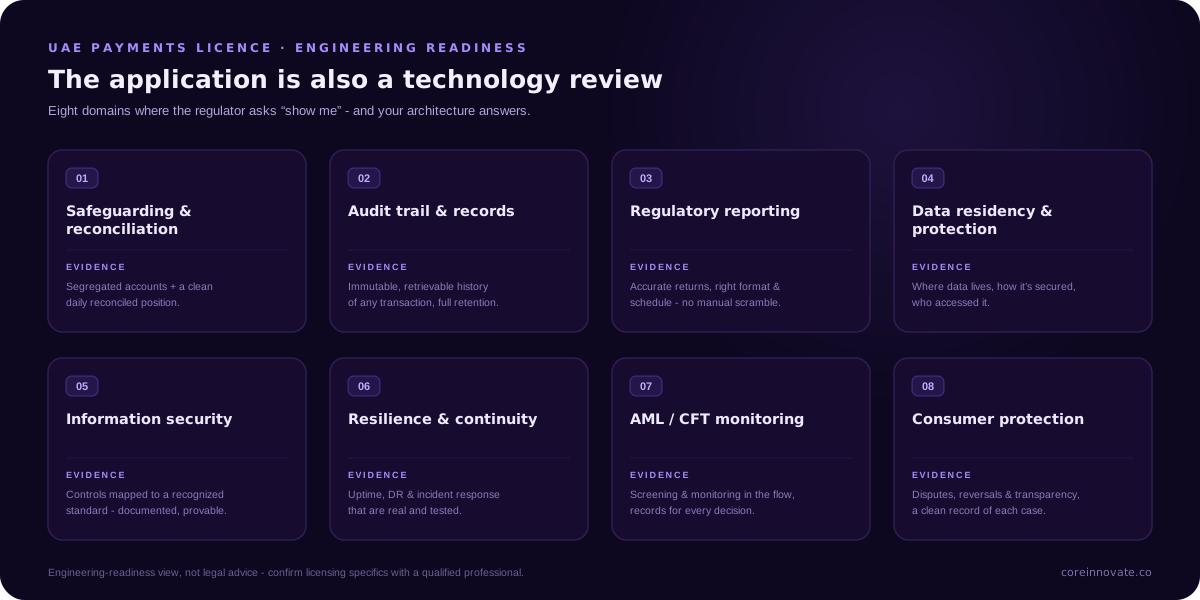
The application is an evidence request
The frameworks a UAE payments business operates under - the CBUAE's regimes covering stored value facilities and retail payment services, and, increasingly, its Open Finance framework - share a common engineering implication, whatever their legal detail. Each one presumes that your platform can demonstrate, on demand and with records, that it does what your policies claim. Regulatory readiness, from an engineering seat, is the ability to produce that evidence quickly, completely, and consistently.
That reframes the whole exercise. You are not building features to pass an audit; you are building a system whose normal operation continuously generates the proof an audit will ask for. The eight domains below are where that proof is most often demanded - and most often missing.
The eight readiness domains
1. Safeguarding and reconciliation. The regulator's central concern for any business holding customer funds is that those funds are protected and accounted for. Engineering-side, that means segregated-account handling wired into the money-movement logic, and reconciliation that runs continuously and produces a clean, auditable daily position - not a spreadsheet assembled under deadline. If you cannot show a reconciled position for any given day on request, this is the first thing to fix. We covered why manual reconciliation fails to meet this bar in The Hidden Cost of Manual Reconciliation in Wallet Platforms.
2. Audit trail and record-keeping. Every money-affecting action must leave a complete, tamper-evident, and retrievable record, retained for the period the regulator requires. "Retrievable" is the word that catches teams out: logs that exist but cannot be queried to reconstruct a specific transaction's full history are not an audit trail. This is an architectural property - append-only event records, immutable by design - not a logging afterthought, a point we develop in Observability for Transaction-Critical Systems.
3. Regulatory reporting. You must be able to produce the required regulatory returns - accurately, in the prescribed format, on the prescribed schedule - without a manual data-gathering scramble each period. If your reports are assembled by exporting from three systems and joining them by hand, the regulator's real question ("can you sustain this accurately, every period, at scale?") has an uncomfortable answer. Reporting should be a query against a system of record, not a monthly project.
4. Data residency and protection. You must be able to state clearly where customer and transaction data physically resides, how it is protected at rest and in transit, and how access to it is controlled and logged. Data-localization expectations in the region make "where does the data live" a first-class architectural question, not a deployment detail to settle later.
5. Information security. The regulator expects security controls aligned to a recognized standard, evidenced rather than asserted. This is where the OWASP baseline we wrote about in What Is OWASP - and Why Payment Platforms Can't Ignore It becomes part of the licensing story: broken access control, injection, and misconfiguration are not just security risks, they are gaps a technical reviewer can find and a licence can stall on. Controls must exist, be documented, and be demonstrable.
6. Resilience and business continuity. Uptime commitments, disaster recovery, and incident response are expected to be real and tested, not documented aspirations. A DR plan that has never been exercised is a policy, not a capability - and the difference is exactly what a mature review probes.
7. AML and CFT monitoring. Sanctions screening, transaction monitoring, and the ability to detect, record, and report suspicious activity must be built into the transaction flow, with the audit trail to prove each decision. This is both a policy obligation and an engineering one: the monitoring has to actually see every transaction, in near-real time, with defensible records.
8. Consumer protection and dispute handling. Complaint handling, dispute and reversal flows, and transparency to the customer must be operational and evidenced. The engineering substance here is the reversal and dispute machinery - the same machinery we examined in Building a Reversals and Disputes Engine for a Digital Wallet Platform - and its ability to produce a clean record of how each case was handled.
Why this is architecture, not paperwork
Read the eight together and the theme is singular: every one is a demand for evidence the system produces as a byproduct of running correctly. Safeguarding is proven by reconciliation the system already does. Record-keeping is proven by an event log the system already writes. Reporting is proven by a query against a system of record that already exists. When these are architectural properties, the licence review is a matter of showing the regulator what the system already generates. When they are not, the review becomes a scramble to manufacture evidence after the fact - and that scramble is where applications stall.
This is why we treat regulatory readiness as an architecture problem rather than a compliance-checklist problem. The teams that sail through the technology review are not the ones with the thickest policy binders; they are the ones whose systems were built so that "show me" has a one-query answer. That is the same architectural discipline our payment platform engineering work is built around - and it pays off long after the licence is granted, because every one of these eight domains is also just good operational practice.
Before you apply
If you are approaching a UAE licence application, the most useful thing you can do on the engineering side is self-assess honestly against these eight domains and find the gaps while you still have time to close them - not when the regulator's technical reviewer finds them for you. Our architecture assessment is scoped to do exactly that: a senior payment engineer reviews your stack against each readiness domain and tells you, directly, where your evidence is clean and where it would not survive scrutiny - so you walk into the application knowing the answer to "show me" before it is asked.
Again: this is an engineering-readiness perspective. The authoritative requirements are the CBUAE's, and your specific obligations should be confirmed with qualified legal and compliance advisors before you rely on any of the above.
CoreInnovate
Working on a payment platform challenge?
Our specialist engineers work directly with payment gateways, wallet providers, and fintech platforms. Start with a scoped architecture assessment.