
T+2 to Same-Day: The Ledger Architecture Behind Faster Settlement
Settlement is slow for architectural reasons, not physical ones. T+2 is what a batch-reconciled ledger can support; same-day is what a continuous one can. Here is the ledger architecture that compresses two business days into hours - and why it is becoming the competitive bar in Gulf payments.
When a platform settles at T+2, the money is not physically in transit for two days. The rails can move value far faster than that. The delay is architectural: T+2 is simply the fastest cadence a batch-reconciled ledger can safely support. Compress the architecture and you compress the timeline - which is why "same-day settlement" is not a rails upgrade or a banking relationship, but a property of your ledger.
We saw this directly on a wallet platform that moved from T+2 to same-day settlement. The rails did not change. The correspondent relationships did not change. What changed was the ledger underneath - from a system that could only prove its position once a day to one that could prove it continuously. This article is about that change: why the ledger sets the settlement clock, and what architecture moves it from two days to hours.
Why T+2 exists
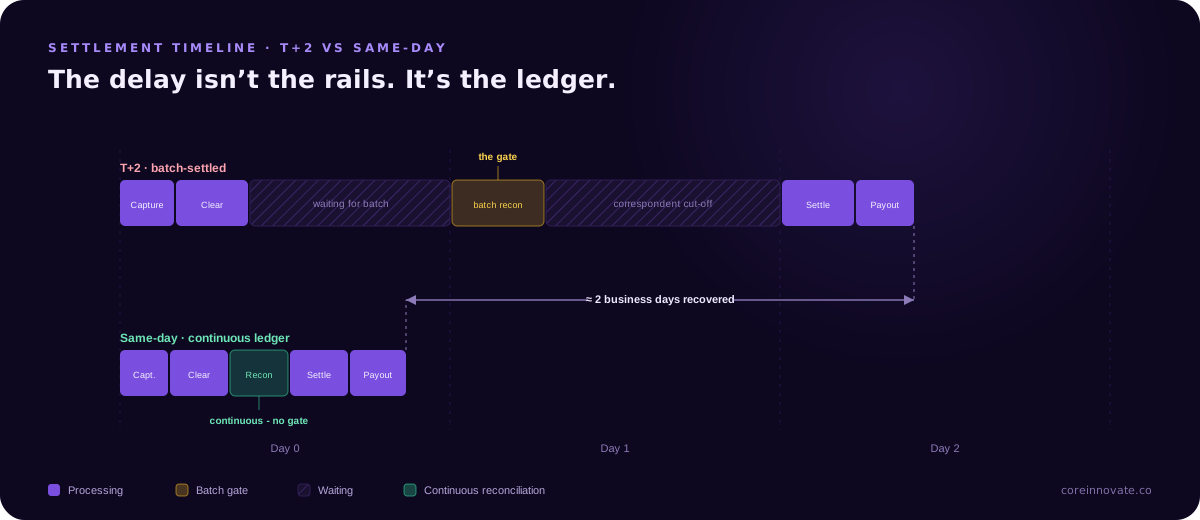
T+2 is not a law of physics. It is the accumulated slack of a settlement process built around a ledger that is only trustworthy in batches. Three architectural facts create it.
Settlement waits for reconciliation, and reconciliation is a nightly batch. You cannot safely settle a position you cannot prove, and in most platforms the position is only proven when the nightly reconciliation batch completes - matching internal records against external statements after the day closes. Settlement therefore cannot happen until the next day at the earliest, because that is when the ledger is first known to be correct.
Clearing and settlement are coupled. When the act of settling is bolted directly onto the batch that clears and nets the day's transactions, settlement inherits the batch's cadence. It runs when the batch runs - once a day - not when a given transaction is actually final.
Correspondent cut-offs add another day of slack. Once reconciliation and netting complete, the settlement instruction still has to catch a correspondent's processing window. Miss today's cut-off and you are into the next business day. Stack these three sequential waits and two days is what falls out - not because moving the money is slow, but because proving it is safe to move is slow.
The ledger is the settlement clock
Every one of those waits traces back to the same root: a ledger that is only correct in retrospect. If your source of truth is reconciled once a day, then once a day is the fastest you can settle against it. The ledger is the clock, and a batch ledger ticks once every 24 hours.
The lever, then, is to make the ledger continuously correct instead of correct-at-midnight. A ledger that is always reconciled, always current, and always provably consistent removes the reason settlement had to wait for tomorrow. This is the same principle we argued from the design side in Ledger Design Principles for Wallet Platforms: the ledger is not a reporting layer, it is the operational core, and its properties determine what the whole platform can do - including how fast it can settle.
The architecture that compresses the timeline
Moving from T+2 to same-day is a set of specific, well-understood changes to that core. None of them is exotic; together they change what cadence the ledger can support.
An event-sourced, append-only double-entry ledger. The source of truth becomes an immutable stream of balanced postings, current by construction rather than assembled nightly. Because every state is derived from the event log, the position at any instant is knowable and provable - there is no "wait for the batch to find out where we are."
Idempotent postings. For a ledger to be trusted continuously, retries and duplicate messages - inevitable in any distributed payment system - must never double-post. Idempotent posting keys make re-delivery safe by construction, which is the precondition for reconciling in real time instead of catching errors in a nightly sweep. This is the discipline we covered in Building Idempotent Payment APIs, applied to the ledger itself.
Continuous reconciliation. Instead of a nightly batch that gates settlement, reconciliation runs continuously against the event stream, so the ledger is provably matched at all times and exceptions surface within minutes. The gate that used to hold settlement until tomorrow simply is not there anymore.
Clearing decoupled from settlement. Settlement is triggered by confirmed ledger state - a transaction being final and reconciled - not by the completion of a daily netting batch. Once a position is provably good, it can settle, without waiting for a batch boundary it no longer depends on.
Liquidity positioned for the timeline you want. Same-day settlement requires funds to be pre-positioned so a confirmed payout can move within the day rather than waiting on a funding cycle. This is a treasury and prefunding design question, but it only becomes tractable once the ledger can tell you your true position in real time - which the changes above provide.
Real-time provability. Finally, the platform must be able to show its position at any moment - not just hold it. The same transaction-level observability that makes the system auditable, which we covered in Observability for Transaction-Critical Systems, is what lets you settle continuously with confidence and prove, on demand, that each settlement rested on a correct position.
Why this is the competitive bar in the Gulf
In high-volume Gulf remittance corridors, settlement speed is no longer a back-office metric - it is a product feature. A platform that settles same-day can offer a payout proposition that a T+2 competitor structurally cannot match, and increasingly customers and partners expect it. As instant and near-instant rails spread across the region, T+2 reads less like a technical constraint and more like a signal that the platform's core was not built for the pace of the market it now operates in. The wallet platform we mentioned did not pursue same-day settlement for its own sake; it did so because same-day payout unlocked a proposition its market was starting to demand - and the ledger was what stood between it and the offer.
You do not rewrite the core to get there
The reassuring part: this is not a big-bang ledger replacement. The move to an event-sourced, continuously-reconciled core can be made incrementally - introduce the event log alongside the existing ledger, bring reconciliation continuous, decouple settlement from the batch, and retire the old path once the new one is proven - all while the platform keeps running. It is exactly the kind of core modernization our wallet and ledger engineering practice is built to do without stopping the business.
If your platform settles at T+2 and you are wondering what it would actually take to reach same-day, that is a scoped, answerable question. Our architecture assessment examines your ledger, reconciliation, and settlement path specifically, and gives you a direct read on where the two days are going and what it would take to get them back.
CoreInnovate
Working on a payment platform challenge?
Our specialist engineers work directly with payment gateways, wallet providers, and fintech platforms. Start with a scoped architecture assessment.