
Why Exchange House Core Systems Fail on Peak Remittance Weekends
The surge is the most predictable event in Gulf remittance - payday, Eid, the end of Ramadan. Exchange houses know exactly when it arrives, and their core systems fail on schedule anyway. This is why legacy cores buckle at peak, and what a system built for the surge looks like instead.
There is no such thing as a surprise peak in Gulf remittance. The surge arrives on a calendar everyone can read: the last working days of the month when salaries land, the days before Eid al-Fitr and Eid al-Adha, the final stretch of Ramadan. An exchange house can tell you months in advance, to the day, when its volume will triple. And yet these are exactly the days its core system slows to a crawl, times out at the counter, and leaves settlement staff reconciling into the following week.
That combination - a completely predictable surge and a completely repeatable failure - is the clearest signal we know of that the problem is architectural, not operational. You cannot staff your way out of a system that falls over at a load you can forecast. This article is about why exchange-house cores fail at peak specifically, and what a core built for the surge does differently.
The core was designed for a different era
Most exchange-house core systems were architected for a branch-counter business: a bounded number of tellers, each processing transactions at human speed, during business hours, with quiet nights and weekends for batch work. That design was correct for the world it was built in. The problem is that the world changed underneath it.
Digital channels - apps, web, aggregator APIs, partner integrations - removed every one of those assumptions. Concurrency is no longer bounded by counter positions; it is bounded by how many customers open the app at once, which on a payday evening is a different order of magnitude. There is no quiet night for batch work, because the digital channel never closes. And traffic is no longer smoothed by the physical friction of walking into a branch; it spikes the instant salaries hit accounts.
A core built for tens of concurrent tellers is now being asked to serve tens of thousands of concurrent sessions, on the exact evenings it was historically allowed to rest. It does not fail because it is old. It fails because it is being used in a way its architecture never assumed - and peak weekends are when that mismatch becomes visible.
The five failure modes we see at peak
When we review an exchange-house platform after a bad peak weekend, the post-mortem almost always lands on the same handful of causes. They compound - each one makes the next worse - which is why the failure feels sudden even though the load was predictable.
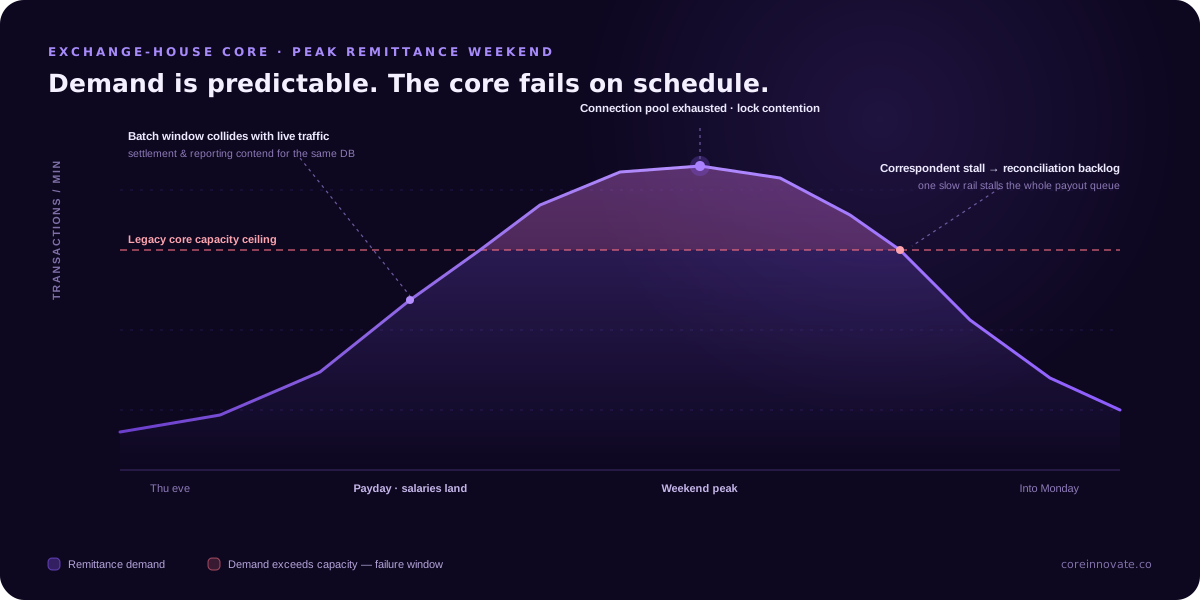
The batch window collides with live traffic. Legacy cores assume a nightly quiet period to run settlement, reconciliation, and reporting batches that hold locks and consume database capacity. On a peak weekend there is no quiet period - the batch job and the live payday surge contend for the same database at the same moment, and both degrade. The batch runs long, the live channel slows, and the two starve each other.
The single database exhausts its connections and locks. Most of these cores route everything - reads, writes, reporting - through one primary database. At peak, the connection pool saturates, new requests queue for a connection that never frees, and lock contention on hot rows (a shared sequence, a balance table, a settlement ledger) turns concurrent transactions into a single-file line. Latency climbs non-linearly, and the counter that took two seconds now takes forty.
A slow correspondent stalls the entire queue. Payout legs often call correspondent banks and partners synchronously, in the same request that the customer is waiting on. When one correspondent slows down at peak - and at peak, at least one always does - every transaction routed through it blocks, holding threads and connections that everything else needs. One slow rail becomes a platform-wide stall, because there is no isolation between a healthy corridor and a struggling one.
Reconciliation cannot keep pace and the backlog compounds. When settlement and reconciliation are partly manual - or automated but single-threaded - a peak weekend generates more transactions than the process can clear in a day. The unreconciled backlog rolls forward, exceptions accumulate, and staff spend the following week catching up instead of preparing for the next surge. The failure does not end when the weekend does.
There is no load isolation between channels. Because all channels share one core, one path, one database, a spike in a single high-volume corridor consumes the shared capacity that every other corridor and every branch counter also depends on. A surge in one place becomes an outage everywhere. The system has no way to protect its healthy traffic from its hottest.
These are the same structural weaknesses we described in the context of scale generally in Scaling Payment Gateways Beyond 1 Million Transactions Per Day and Why Wallet-to-Wallet Transfers Break at Scale - here they simply all arrive on the same predictable evening.
What a core built for the surge does differently
None of this requires exotic technology. It requires an architecture that assumes the surge instead of hoping to survive it.
Settlement and reporting move off the live path. Batch work is decoupled from the transaction path entirely - event-sourced transaction records feed asynchronous settlement and reconciliation processes that run continuously, not in a nightly window that can collide with traffic. There is no batch-versus-live contention because there is no batch window to defend.
Reads and writes are separated, and hot contention is designed out. Reporting and read-heavy queries are served from replicas, not the write primary. Sequences, balances, and ledger updates that used to be single points of lock contention are re-designed - partitioned, sharded by corridor or account, or restructured around append-only event streams - so that concurrency scales instead of serializing. This is architecture work, not tuning; it is the class of problem our scalability and performance engineering practice exists for.
Correspondent calls are asynchronous and isolated. Payout legs are queued and processed independently of the customer-facing request, with circuit breakers and timeouts around every correspondent integration, so that a slow rail degrades only its own corridor - not the whole platform. A struggling partner is contained, not amplified.
Reconciliation is continuous and automated. Instead of a daily batch that a peak weekend can overwhelm, reconciliation runs against the event stream in near-real-time, so the backlog never accumulates and exceptions surface while they are still small and cheap to resolve.
Channels are isolated so a surge stays contained. Capacity is allocated so that a spike in one corridor cannot starve the others or the branch network - through separate resource pools, rate limiting, and load shedding that protects the platform's baseline rather than letting one hot path take everything down with it.
The surge is a test you can run before it runs you
Here is the part exchange houses most often miss: because the peak is predictable, it is also reproducible. You do not have to wait for the next Eid to find out whether your core survives it. The failure modes above can each be provoked deliberately, under a synthetic version of your real peak profile, in a controlled test - and that is the difference between finding your breaking point in a load test and finding it at the counter with customers waiting. We made this argument in general terms in Why Your Last Load Test Is Giving You a False Sense of Security; for an exchange house, the peak-weekend profile is the single most important load test you are probably not running.
And critically, none of the fixes above require a big-bang rewrite of the core. Each failure mode can be addressed incrementally - move settlement off the live path, add a read replica, wrap the correspondent calls, isolate the hottest corridor - alongside a running business, using a strangler-fig approach that modernizes the parts that fail at peak without stopping the parts that work. The peak weekend tells you exactly which parts to address first: they are the ones that broke last time, on schedule.
If your last peak weekend ended in a settlement backlog and a counter that timed out, that is not bad luck and it will not fix itself before the next one. Our architecture assessment is scoped to find exactly why your core buckles at peak - the batch collisions, the contention points, the synchronous correspondent calls, the missing isolation - and to give you a prioritized, incremental path to a core that treats the surge as a Tuesday.
CoreInnovate
Working on a payment platform challenge?
Our specialist engineers work directly with payment gateways, wallet providers, and fintech platforms. Start with a scoped architecture assessment.